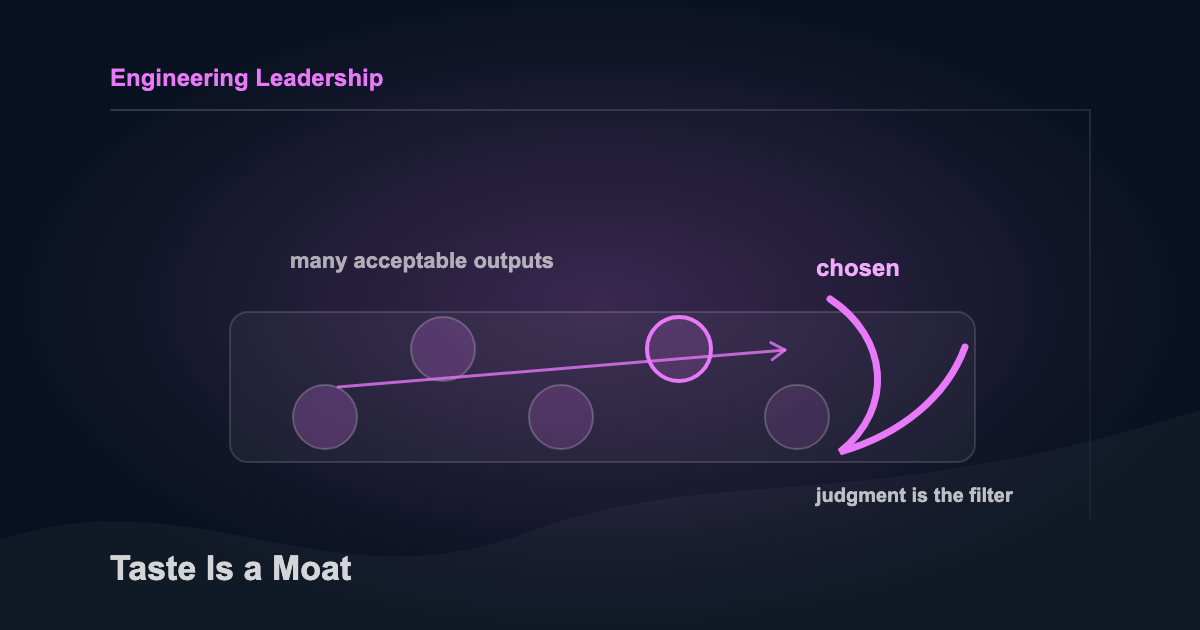
“Taste is a moat.” “Avoid AI slop.” You see those lines everywhere right now.
But what do they actually mean? How is taste determined, and why does it matter so much?
Here are my thoughts…
Taste is subjective but it’s not arbitrary. It’s rooted in feeling — wanting to be liked, wanting to be accepted, wanting to seem smart. Eventually those motivations turn into pride and craft, and the craft is the thing you can see in the work (output).
Which is why AI can’t get there.
Taste lives in the chooser
Taste is earned through lived judgment, the kind that separates us from them.
It comes from defending a choice to peers who pushed back. From late hours meeting a deadline. From social norms you broke (on purpose or by accident) and had to sit with. Each one leaves a small calibration mark.
Taste forms early. Maybe things came naturally to you, or maybe you had to grind through something you weren’t good at. Either way, those hours of repetition drilled little thoughts into your head. “You gotta make the leap.” “Keep that left foot down.” “Moving too fast.” Thousands of tiny feedback loops.
Taste only develops from doing. It doesn’t come from reading, and it doesn’t come from inference.
From System 2 to System 1
Another way I think about it comes from Kahneman’s Thinking, Fast and Slow. System 2 is deliberate thinking — slow, effortful, conscious. System 1 is fast and automatic. Taste is what happens when System 2 runs so often on the same kind of decision that it drops into System 1. Choices aren’t conscious anymore. You just know.
And it shows up everywhere. Clothing choices. Writing patterns. Knowing what to say at 2am to an angry tenant whose pipe broke. The email to the CEO with your big proposal. That’s all taste in the form of judgment fast enough to feel like instinct. Real life teaches weight, proportion, what’s important, what survives contact with reality.
Taste comes from omission too. What you decided not to do, what you cut, the font you avoided, the slogan you didn’t choose. Taste is the refusal mechanism that protects quality.
You know it when you see it
Taste itself is hard to describe. It’s like porn — you know it when you see it. The difference is almost always in the small details. Ken Griffey Jr.’s swing. Roger Federer’s backhand. Paul Rand’s logos. Frank Lloyd Wright’s homes. Everything looks fluid and effortless, but only because the sweating happened a long time ago. In that sense, taste is a skill. It can be refined.
Poor taste is the easy mirror
You learned this early too, by making a crude comment about a friend’s sister and getting punched in the nose. By making a bad joke nobody laughed at. You feel it in the used car salesman’s pitch, in the bad piece of copy where you know you’re being sold to. You can feel the calibration miss. Something pushy, or polished in the wrong way. A pitch that tried too hard, or didn’t try hard enough.
Poor taste and slop feel low intelligence, and that’s the point. Models getting smarter won’t change it. The feeling is about whether anyone actually chose. Whether any decision in the work cost the maker something. Whether someone even cared. Output quality is downstream of all of that.
Where the moat lives
The copycat vs the originator. The amateur vs the master. Masters don’t overlook subtleties, and it’s always in the small details, because at some point those details were the whole problem. They had to sweat them to get where they are. The details stopped being small to them a long time ago.
And that is where the moat lives.